


An Ancient and Deep-Rooted Devotion
The devotion of the people of Morano Calabro to the Our Lady of Graces, affectionately known as “Mamma ‘e Grazia,” has its roots in the pre-Christian era, passed down from generation to generation until the present day. Numerous writings by local historians, such as the famous doctor Gio’ Leonardo Tufarello, Salmena, and the provost Scorza, attest to the deep veneration of the Virgin by the people, who, since the early days of Christianization in Morano, considered her the first patroness of the city.
Between Legend and History: The Foundation of the Church and the Link with St. Bernardino
According to tradition, the foundation of a small temple dedicated to the Our Lady of Graces dates back to 56/60 AD, erected by the Morano people who had converted to Christianity through the preaching of Stephen of Nicaea, a disciple of Paul. Its location, outside the settlement, would testify to the importance of Morano in the 1st century, similar to other cities converted by the apostles.
In 1496, following the Aragonese conquest of Morano, the protection of the city was also entrusted to St. Bernardino of Siena. Legend has it that the Grand Captain Consalvo, upon meeting a friar who recommended the city to him, recognized the wooden statue of St. Bernardino as the saintly monk who had appeared to him in a dream, asking him to spare the population. Consalvo, moved, laid down his sword at the feet of the statue, and from then on, St. Bernardino became the second protector of Morano.
The New Church and the Decline of the Ancient Sanctuary
In the 17th century, during a dispute over the preeminence between parish churches, the archpriest Don Veneziano Barbastefano built a new church dedicated to St. Nicholas of Bari, more dignified and better furnished than the old sanctuary of the Our Lady of Graces. The old sanctuary, deprived of its independent entrance and accessible only through the upper church, gradually declined, culminating in its complete destruction and alienation to private ownership.
The Revival of Devotion and the Terrarossa Chapel
Despite the abandonment of the ancient sanctuary, devotion to the Our Lady of Graces did not fade. In 1888, Archpriest Salvatore Salvati promoted the construction of a “small temple” along the road connecting the Terrarossa district to the historic center of Morano. This chapel became the new place of Marian worship, symbolizing the revival of devotion and the deep faith of the people of Morano towards their “Mamma ‘e Grazia.”
A Heritage of Faith and History to Preserve
The devotion to Our Lady of Graces represents an invaluable heritage of Morano Calabro, intertwining history, faith, and legend. The Terrarossa chapel, with its simplicity and intimate atmosphere, is a testimony of the uninterrupted devotion of the people of Morano to their protector, a bond that spans centuries and is renewed over time.
Architectural and Artistic Features of the Madonna delle Grazie Church
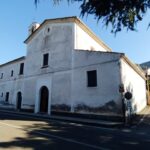
The chapel of Our Lady of Graces in Morano Calabro, built between 1888 and 1897, is a solid and harmonious building, despite the presence of humidity on the western wall. Its rectangular floor plan with a single nave, covered by a barrel vault, is divided by three arches on each side, supported by pilasters with Doric capitals and topped with large windows that illuminate the interior. The ceiling is decorated with stucco depicting elegant floral motifs and angelic figures, while the arch above the presbytery bears the emblem of the Salvati family, who promoted its construction.
A Rich Presbytery of History and Art
The presbytery, raised about 20 centimeters above the terracotta floor, originally housed the main altar made of cocciopesto, which was replaced at the end of the 20th century by the current walnut altar. Behind it, on the central wall, there is a fresco from 1898 by P. Carmine Donadio depicting the Holy Trinity, while on the vault of the nave, another fresco by the same author shows the Visitation of Mary to her cousin Elizabeth. Two devotional statues of the Our Lady of Graces, both 20th-century works, complete the sacred furnishings of the presbytery.
A Monumental Entrance and an Eloquent Facade
The main entrance of the chapel is surmounted by a wooden choir gallery still used by the parish choir and a plaque commemorating the artist behind the decorations, Giuseppe Aronne di Piè. The external facade, simple and made of squared and well-aligned tuff blocks, features a niche with a statue of the Madonna above which an inscription describes the construction of the chapel, commissioned by Monsignor Salvatore Salvati with the contribution of the people and designed by architect Gaetano Morelli.
The Connection Between the Churches of Our Lady of Graces and Our Lady of Health
The church of Our Lady of Graces is currently connected to the 16th-century chapel of Our Lady of Health, located adjacent, through an opening made on the left side of the nave. This chapel was erected by the White Brotherhood, for a grace received through the intercession of St. Francis of Paola, by one of the members of the brotherhood. This occurred after the canonization of St. Francis (1519), and certainly after 1576.
The altarpiece on the sole altar of the chapel, reconstructed in 1941, depicts in the central panel the Our Lady of Health; to her left, St. Vito; to her right, St. Francis of Paola. In two panels inserted in corresponding frames, the Madonna of the Annunciation (on the right) and the Archangel Gabriel (on the left) are visible. At the top, the image of God the Father, surrounded by a pair of flying angels. At the lateral ends, barely visible, are portraits of St. Peter and St. Paul, respectively on the left and right. The work is elevated above the only altar in the chapel, made of rough plaster lightened by a painted frontal and a carved and gilded wooden frame, made by local woodworkers in the 17th century. It was roughly reassembled by Don Pietro Mainieri in 1941, and the liturgical table has not been used for about fifty years.
A Recent Restoration and New Historical Clues
A recent restoration work on the wooden coffered ceiling and the roofing has partially restored the original beauty of the chapel. Outside, the remains of perimeter walls and the pediment of an ancient structure, likely a chapel outside the walls of St. Vito or a building related to the Our Lady of Health chapel, are visible. Historical and archaeological clues suggest that burial sites from a period before the Edict of Saint Cloud may have been located in the surrounding area. A careful excavation campaign could confirm these hypotheses and uncover further details about the site’s past.
The Our Lady of Graces and Our Lady of Health Churches: A Heritage to Be Valued
The Our Lady of Graces and Our Lady of Health churches, with their harmonious architecture, artworks, and rich history, represent a precious heritage of Morano Calabro. Their enhancement, through restoration and historical-archeological studies, would help preserve the memory of the past and enrich the cultural offering of the area.
 Previous Post
 Next Post


