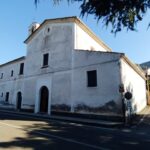
Next to the Church of the Magdalene and just a few steps from the Town Hall stands the Carmine Church, a hidden treasure of Morano Calabro. Originally the seat of the Confraternity of the Carmine, the chapel has housed valuable works of art since the 16th century and boasts a rich history tied to the assistance of pilgrims and the needy.
A Masterpiece by Pedro Torres
Inside the chapel, the main altarpiece is a true artistic gem. Created in 1594 by Pedro Torres, a Flemish painter active in Naples, the painting depicts the Madonna with Child between Saint Francis of Paola and Saint Lucia. This work, the first commission given to Torres by the people of Morano, marks the beginning of a series of masterpieces that continue to adorn the churches of the town. The Carmine altarpiece, in particular, stands out for its 1652 carved and gilded wooden frame, which enhances the beauty of the composition.
Baroque Elegance and Calabrian Masters
The chapel is enveloped in an elegant wall decoration of stucco work from 1784, framing a Marian-themed painting cycle. Among the standout works is the “Coronation of the Virgin” (c. 1795) by Cristofaro Santanna, a Calabrian painter from Rende. Santanna is also responsible for the “Last Supper” (1785) on the ceiling of the choir in the nearby Church of the Magdalene.
Noteworthy is the 18th-century organ, dated 1732 and signed by Gennaro Cociniello, partly crafted on site. The 19th-century wooden furnishings of the chapel, including the balustrade, prior’s chair, and the statue niches, follow the ‘alla Fusco’ style, later reinterpreted by the Frunzi family.
Rediscovered Memories and Precious Vestments
In 1995, the Chapel of the Carmine hosted the exhibition “Rediscovered Memories,” an opportunity to highlight restored artworks from the churches of Morano. Among the most valuable finds were a pair of leather altarpieces, part of a set of six, which had come to the Chapel of the Carmine from the Capuchin chapel. Created in Venice between the late 18th and early 19th centuries, the vestments are attributed to Francesco Guardi or, at most, his counterpart Antonio de’ Bittio. The exquisite decorations, featuring punchwork, ‘mecca’ gilding, and ‘leaf’ silvering, adorned with floral motifs and medallions depicting figures, showcase the craftsmanship of Venetian artisans of the time.
A Heritage to Discover
The Carmine Church, with its layers of history, art, and craftsmanship, represents an invaluable heritage of Morano Calabro. It is a place to visit to immerse oneself in an atmosphere of beauty and spirituality, admiring masterpieces that tell the story and devotion of the village


 Previous Post
 Next Post